
What Model Context Protocol MCP Means for the Future of AI
What Model Context Protocol MCP Means for the Future of AI – Artificial intelligence is rapidly evolving from a tool that answers questions into a system that can perform real-world tasks. Modern AI assistants can search databases, analyze documents, schedule meetings, access business software, and even collaborate with other AI agents. However, one major challenge has slowed this transformation: connecting AI models to external tools and data sources in a standardized way.
This is where Model Context Protocol (MCP) enters the picture.
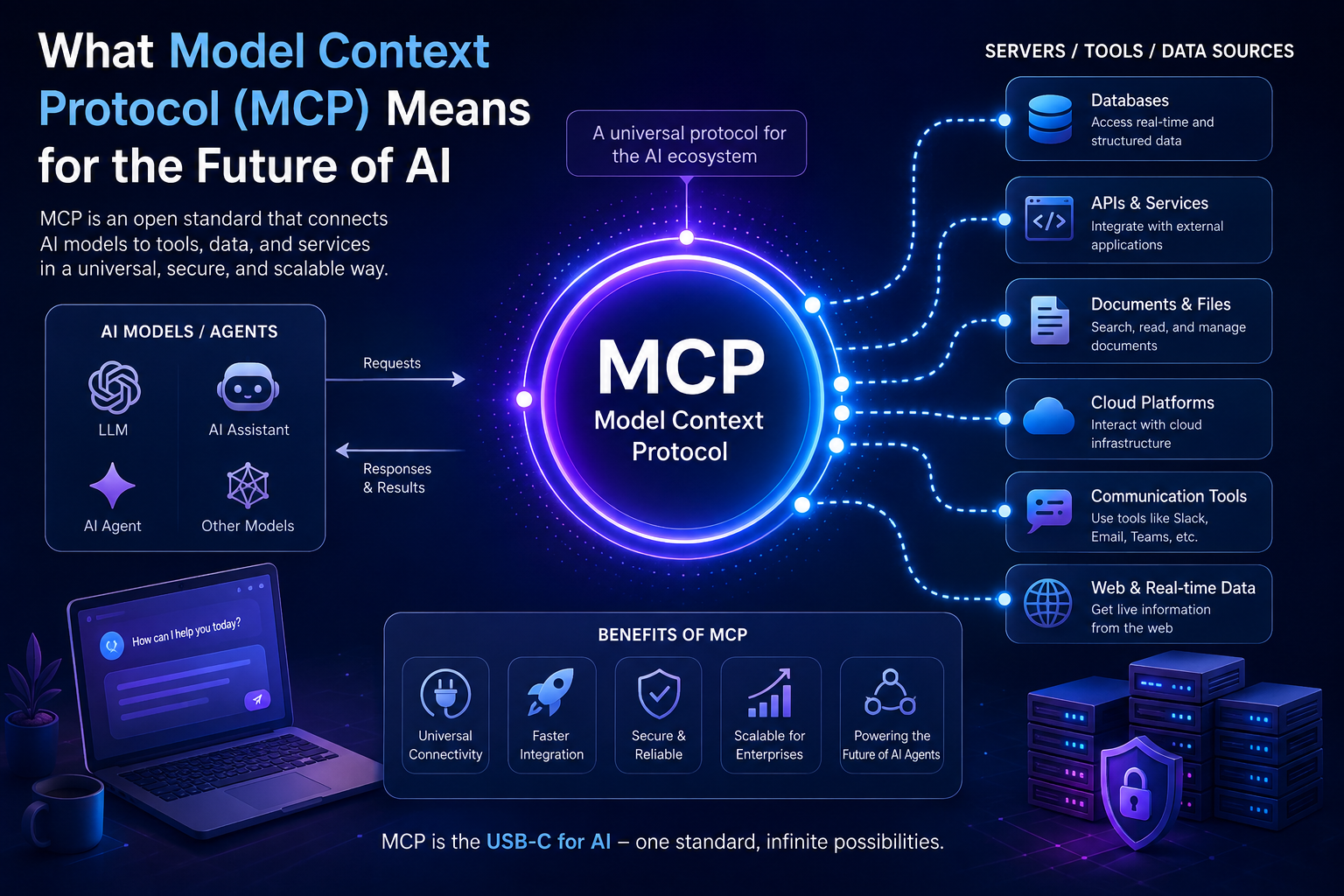
Often described as the “USB-C for AI,” MCP is becoming one of the most important developments in the AI ecosystem. It provides a universal method for connecting large language models (LLMs) to applications, databases, APIs, and digital services. Instead of creating custom integrations for every AI tool, developers can use a single open standard that works across multiple platforms.
As AI agents become more capable and autonomous, MCP could play a role similar to what HTTP played for the web or what USB played for hardware connectivity.
What Is Model Context Protocol
Model Context Protocol is an open protocol designed to standardize how applications provide context, tools, and data to AI models. The protocol was originally introduced by Anthropic and has rapidly gained adoption across the AI industry.
In simple terms, MCP allows AI systems to communicate with external resources through a common language.
Without MCP, developers often need to build separate integrations for every application an AI system must access. For example, connecting an AI assistant to Slack, GitHub, Google Drive, databases, and CRM software typically requires multiple custom APIs and workflows.
With MCP, these services can expose standardized interfaces, allowing AI systems to access them more easily and consistently.
The result is a more interoperable AI ecosystem where tools can be connected once and used across many AI platforms.
Why MCP Matters
Current AI models are incredibly powerful, but they have limitations.
Most large language models are trained on historical data and cannot automatically access real-time information unless connected to external systems. They also cannot perform actions such as updating records, creating files, or interacting with enterprise software without specialized integrations.
MCP addresses this problem by providing a framework for:
- Accessing live data
- Connecting to enterprise systems
- Using external tools
- Executing actions
- Sharing context between systems
- Supporting AI agent workflows
This enables AI models to move beyond simple conversation and become active participants in digital workflows.
How MCP Works
The protocol is based on a client-server architecture.
An AI application acts as the client, while external services expose functionality through MCP servers.
For example:
- A database can expose search capabilities through an MCP server.
- A project management platform can expose task creation tools.
- A file system can provide access to documents.
- A news service can allow AI systems to retrieve current information.
When a user requests a task, the AI model can discover available tools and decide which ones are needed to complete the job.
This process makes AI systems significantly more useful because they are no longer limited to their training data.
MCP and the Rise of AI Agents
One of the biggest reasons MCP has gained attention is its connection to agentic AI.
AI agents are systems capable of planning, reasoning, and taking actions with minimal human supervision. Unlike traditional chatbots, agents can execute multi-step workflows.
For example, an AI travel assistant might:
- Search flight options
- Compare hotel prices
- Review weather forecasts
- Create an itinerary
- Send booking recommendations
Each step requires access to different services and tools.
MCP provides the infrastructure that allows these agents to communicate with external systems in a standardized manner. Industry adoption has accelerated as organizations build increasingly sophisticated agent workflows.
As agent ecosystems grow, MCP may become one of the foundational layers enabling AI-to-tool communication.
MCP as the USB-C of AI
Many experts compare MCP to USB-C because it solves a similar problem.
Before USB-C, devices required different cables and adapters. Each manufacturer often used proprietary connectors.
Today, USB-C provides a universal standard that simplifies connectivity.
MCP aims to achieve the same outcome for artificial intelligence.
Instead of every AI provider creating unique integration frameworks, MCP provides a common protocol that allows tools and services to work across platforms.
This interoperability reduces development complexity and encourages broader ecosystem growth.
Industry Adoption Is Accelerating
MCP has moved from an experimental concept to a widely adopted standard.
Recent reports indicate that the protocol is being used across a rapidly expanding ecosystem of AI tools and services. Major AI companies and software providers are increasingly supporting MCP-compatible integrations.
The protocol has also evolved significantly.
The latest specification introduces:
- Stateless architecture
- Improved scalability
- Enhanced authorization controls
- Better routing mechanisms
- Support for enterprise deployments
- Formal extension frameworks
These improvements make MCP more suitable for large-scale production environments.
The growing momentum suggests that MCP is becoming a key layer in the emerging AI infrastructure stack.
Enterprise Benefits of MCP
Businesses are particularly interested in MCP because of its ability to simplify AI deployment.
Organizations often operate dozens or hundreds of software systems. Connecting AI to these systems individually can be expensive and difficult to maintain.
MCP offers several advantages:
Faster Integration
Developers can connect AI systems using a standardized interface rather than building custom integrations for every application.
Improved Scalability
New protocol enhancements support stateless communication models that are easier to scale across cloud environments.
Reduced Development Costs
A shared protocol reduces engineering effort and simplifies maintenance.
Better Interoperability
Organizations can switch between AI providers without rebuilding every integration.
These benefits are driving enterprise interest in MCP-based architectures.
Security Challenges and Risks
Despite its advantages, MCP introduces new security concerns.
As AI systems gain access to tools, databases, and business applications, the potential attack surface increases.
Researchers have identified several risks, including:
- Unauthorized access
- Prompt injection attacks
- Tool poisoning
- Privilege escalation
- Supply chain attacks
Academic research has highlighted the need for stronger authentication, identity management, policy enforcement, and auditing mechanisms within MCP ecosystems.
Security researchers have also demonstrated vulnerabilities related to tool execution and server configurations, emphasizing the importance of secure implementation practices.
For MCP to achieve widespread enterprise adoption, robust security standards will remain essential.
MCP and Multi-Agent Systems
The future of AI is increasingly moving toward multi-agent environments.
Rather than relying on a single AI model, organizations may deploy teams of specialized agents that collaborate on complex tasks.
Examples include:
- Research agents
- Coding agents
- Customer service agents
- Financial analysis agents
- Security monitoring agents
The MCP roadmap highlights growing support for agent communication and advanced coordination capabilities.
As multi-agent systems become more common, MCP could serve as the communication backbone that enables agents to access tools and share context efficiently.
The Future of AI Connectivity
The next phase of AI development is unlikely to be defined solely by larger models.
Instead, competitive advantage may come from how effectively AI systems connect to real-world data, software, and services.
Protocols like MCP enable:
- Real-time information access
- Cross-platform automation
- Enterprise workflow integration
- Agent collaboration
- Dynamic decision-making
Industry observers increasingly view MCP as a foundational technology for building AI-native applications and services. Reuters, for example, recently launched an MCP server that allows AI agents to directly access and integrate trusted news content into automated workflows.
This demonstrates how organizations are beginning to treat MCP as a primary channel for AI interaction.
Challenges Ahead
Although MCP shows enormous promise, several challenges remain.
These include:
- Security and governance
- Standardization across vendors
- Performance optimization
- Tool discovery efficiency
- Context management
- Enterprise compliance requirements
Community discussions have also raised concerns about context overhead and scalability, prompting ongoing improvements to the protocol architecture.
The good news is that the MCP ecosystem is evolving rapidly, with active development focused on solving these issues.
Conclusion
Model Context Protocol represents one of the most important infrastructure developments in modern artificial intelligence. By creating a universal standard for connecting AI models to tools, applications, and data sources, MCP helps transform AI from a conversational assistant into a capable digital agent.
Its growing adoption, expanding feature set, and increasing enterprise support suggest that MCP could become a foundational layer of the future AI ecosystem. As organizations invest in AI agents, automation, and intelligent workflows, the ability to connect models to the real world will become increasingly valuable.
Just as the internet relied on common communication standards to achieve global scale, the future of AI may depend on protocols like MCP that enable seamless interaction between models, tools, and services. If current trends continue, Model Context Protocol could become one of the defining technologies powering the next generation of intelligent systems.


