
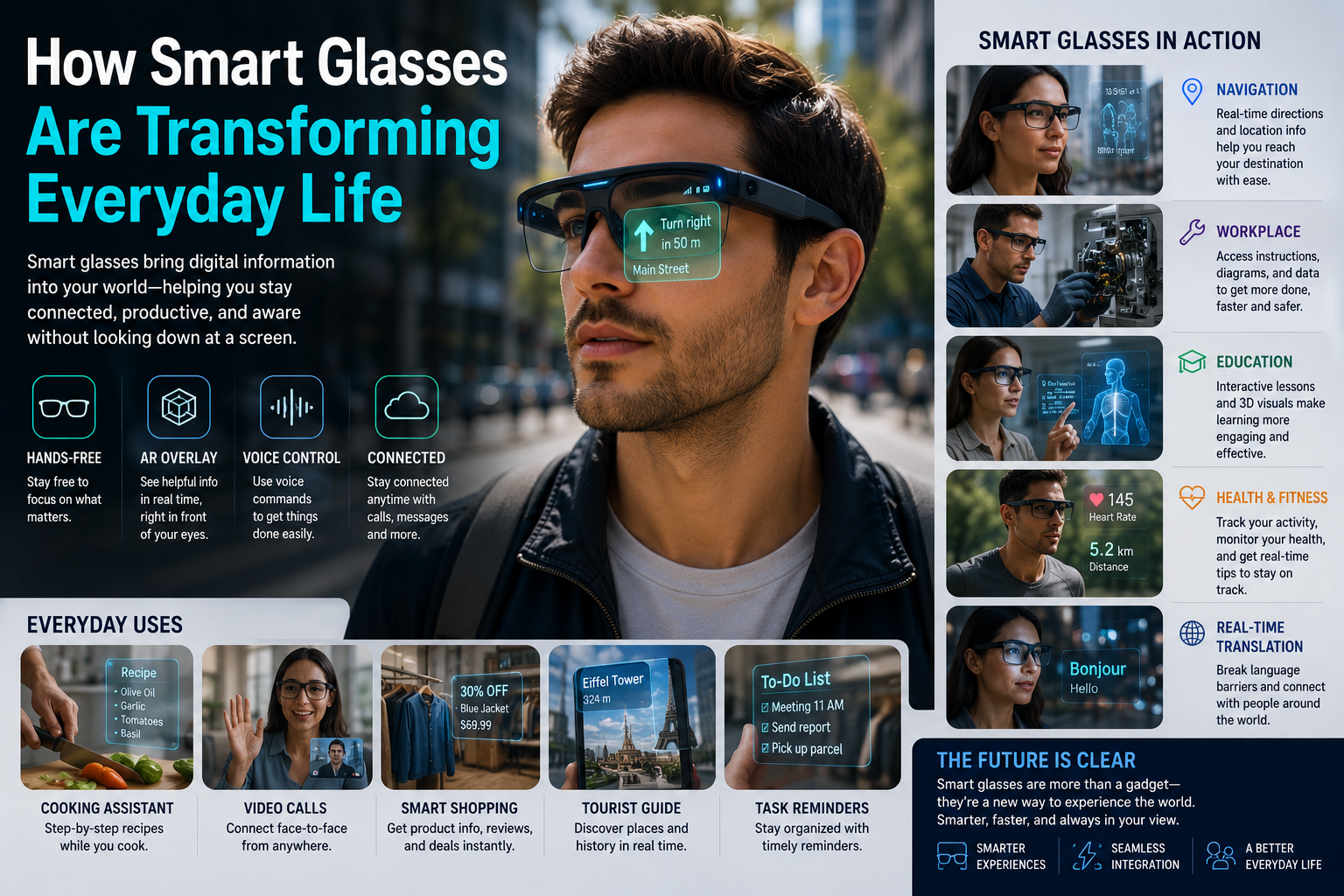
How Smart Glasses Are Transforming Everyday Life
How Smart Glasses Are Transforming Everyday Life – Smart glasses are rapidly emerging as one of the most exciting innovations in wearable technology. Once viewed as futuristic gadgets seen only in science fiction movies, smart glasses are becoming increasingly practical and accessible for consumers and businesses alike. Powered by advances in augmented reality (AR), connectivity, sensors, and miniaturized electronics, these devices are changing how people interact with digital information in their daily lives.
In 2026, smart glasses are moving beyond niche applications and entering the mainstream. From navigation and communication to health monitoring and workplace productivity, they offer new ways to access information without constantly looking at a smartphone screen. As technology continues to evolve, smart glass have the potential to become one of the most important personal computing devices of the future.
What Are Smart Glasses?
Smart glasses are wearable devices that resemble traditional eyeglasses but incorporate advanced digital technologies.
Depending on the model, smart glass may include:
- Augmented reality displays
- Cameras
- Microphones
- Speakers
- Internet connectivity
- GPS navigation
- Sensors
- Voice assistants
These features allow users to access information, communicate, and interact with digital content while keeping their hands free.
Unlike smartphones, which require users to look down at a screen, smart glass provide information directly within the user’s field of view, creating a more natural and seamless experience.
Why Smart Glasses Are Becoming Popular
Several technological and social trends are driving interest in smart glass.
Advances in Augmented Reality
Modern AR technology enables digital content to be displayed directly on lenses or projected into the user’s visual field.
This allows users to view information while remaining aware of their surroundings.
Improved Hardware
Advancements in processors, batteries, displays, and sensors have made smart glass lighter, more powerful, and more comfortable to wear.
Demand for Hands-Free Technology
People increasingly want convenient ways to access information without interrupting daily activities.
Smart glass provide a hands-free alternative to smartphones and other devices.
Growth of Wearable Technology
Consumers have become more comfortable adopting wearable devices such as smartwatches, fitness trackers, and health monitors.
Smart glasses represent the next step in this evolution.
Smart Glasses and Everyday Communication
Communication is one of the most important areas where smart glass are making an impact.
Users can:
- Receive notifications
- Answer calls
- Send messages
- Access voice assistants
- Participate in video communication
Because information appears directly in the user’s field of vision, interactions can be faster and more convenient.
Voice commands further reduce the need to interact with screens or keyboards.
As natural language technologies improve, communication through smart glass is becoming increasingly seamless.
Navigation and Travel Assistance
Smart glasses are transforming how people navigate cities, roads, and public spaces.
Traditional navigation often requires looking at a smartphone or vehicle display.
Smart glass can instead provide:
- Turn-by-turn directions
- Location information
- Public transportation updates
- Travel alerts
- Points of interest
These features improve convenience and safety by allowing users to keep their attention on their surroundings.
Tourists can also benefit from real-time information about landmarks, attractions, and local services.
Enhancing Workplace Productivity
Businesses are adopting smart glass to improve productivity across multiple industries.
Field Service and Maintenance
Technicians can access instructions, diagrams, and maintenance records without carrying tablets or manuals.
This enables faster problem-solving and reduces downtime.
Manufacturing
Workers can receive real-time guidance during assembly and quality control tasks.
Smart glass help improve accuracy and efficiency while reducing errors.
Logistics and Warehousing
Warehouse employees can use smart glass to:
- Locate inventory
- Follow picking routes
- Verify shipments
- Access operational information
This streamlines workflows and increases productivity.
Remote Collaboration
Smart glasses enable remote experts to view what workers see and provide guidance in real time.
This reduces travel costs and accelerates issue resolution.
Smart Glasses in Education
Educational institutions are exploring new ways to use smart glass to enhance learning experiences.
Potential applications include:
- Interactive lessons
- Virtual field trips
- Real-time language translation
- Hands-on training simulations
- Personalized educational content
Students can receive contextual information while interacting with physical environments, creating more engaging learning experiences.
Professional training programs also benefit from immersive and interactive instruction methods.
Health and Fitness Applications
Health and wellness represent another growing area for smart glasses.
These devices can support users by providing:
- Fitness tracking
- Workout guidance
- Health monitoring
- Activity reminders
- Wellness insights
Future smart glasses may integrate additional biometric sensors that provide even more comprehensive health data.
Healthcare professionals may also use smart glass for patient care, medical training, and remote consultations.
Entertainment and Media Experiences
Smart glasses are opening new possibilities for entertainment and content consumption.
Users can enjoy:
- Augmented reality games
- Interactive experiences
- Streaming content
- Live event enhancements
- Virtual displays
Instead of relying on physical screens, smart glasses can create personal viewing environments that travel with the user.
This flexibility may significantly change how people consume digital media.
Real-Time Translation and Accessibility
Language barriers can create challenges for travelers, businesses, and international communication.
Smart glass can provide real-time translation capabilities by displaying translated text or spoken language directly in the user’s view.
Accessibility applications are equally important.
Smart glass may assist individuals with disabilities through:
- Visual guidance
- Object recognition
- Audio assistance
- Navigation support
These features can improve independence and quality of life.
The Role of Augmented Reality
Augmented reality is one of the most important technologies driving smart glass adoption.
Unlike virtual reality, which creates fully immersive digital environments, AR overlays digital information onto the real world.
This allows users to remain connected to their surroundings while accessing useful information.
Examples include:
- Navigation directions appearing on streets
- Product information displayed in stores
- Interactive educational content
- Workplace instructions overlaid on equipment
As AR technology improves, smart glasses will become increasingly capable and useful.
Benefits of Smart Glasses
The growing interest in smart glasses is driven by several key advantages.
Hands-Free Convenience
Users can access information without holding or interacting with a separate device.
Increased Productivity
Quick access to data improves efficiency in both personal and professional settings.
Enhanced Mobility
Smart glasses allow people to stay connected while moving freely.
Better Situational Awareness
Unlike smartphones, smart glasses let users keep their eyes on their surroundings.
Personalized Experiences
Information can be tailored to individual needs, preferences, and locations.
Challenges Facing Smart Glasses
Despite their promise, smart glasses face several challenges.
Battery Life
Powering displays, sensors, and connectivity features in a lightweight device remains difficult.
Manufacturers continue working to improve battery performance.
Privacy Concerns
Built-in cameras and sensors raise questions about data collection and user privacy.
Clear regulations and responsible design practices are essential.
Cost
Advanced smart glasses can be expensive, limiting widespread adoption.
Prices are expected to decrease as technology matures.
Social Acceptance
Some consumers remain hesitant to wear devices that visibly incorporate cameras or AR technology.
Design improvements may help increase acceptance.
The Future of Smart Glasses
The future of smart glasses looks increasingly promising.
Several trends are expected to accelerate adoption:
- Better augmented reality experiences
- More compact designs
- Improved battery technology
- Faster wireless connectivity
- Enhanced voice interaction
- Advanced health monitoring features
Many technology experts believe smart glass could eventually become a major computing platform, complementing or even reducing dependence on smartphones.
As hardware and software continue to evolve, smart glass will likely become more capable, affordable, and widely used.
Conclusion
Smart glasses are transforming everyday life by making digital information more accessible, intuitive, and seamlessly integrated into daily activities. From communication and navigation to education, healthcare, entertainment, and workplace productivity, these wearable devices are creating new opportunities for how people interact with technology.
Powered by advancements in augmented reality, sensors, connectivity, and wearable computing, smart glass are steadily moving toward mainstream adoption. While challenges related to battery life, privacy, cost, and social acceptance remain, ongoing innovation continues to address these limitations.
As the technology matures, smart glass may become one of the defining consumer technologies of the coming decade, reshaping how people work, learn, communicate, and experience the world around them.