
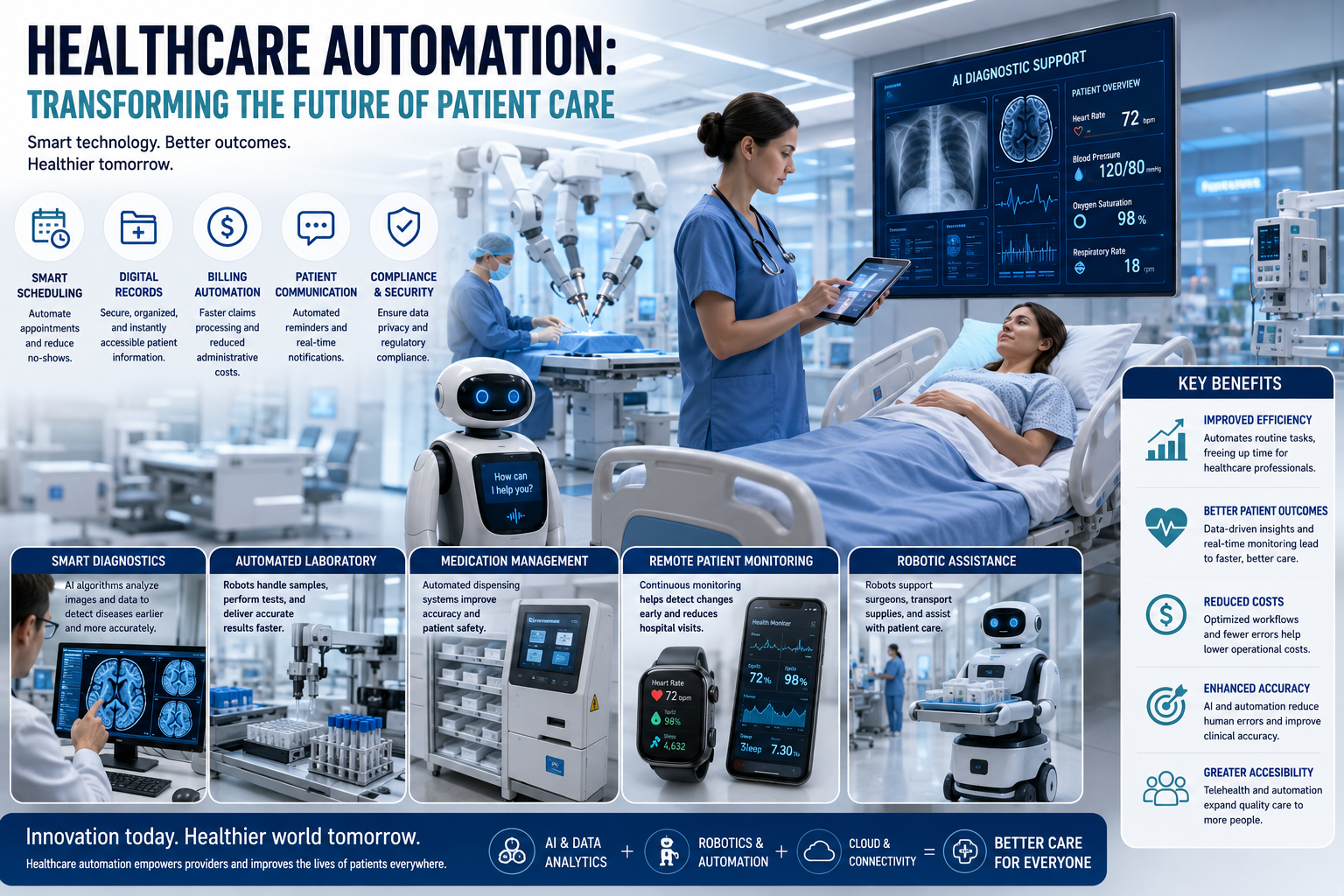
Healthcare Automation: Transforming the Future of Patient Care
Healthcare Automation: Transforming the Future of Patient Care – The healthcare industry is undergoing a profound digital transformation. Hospitals, clinics, laboratories, and healthcare providers around the world are increasingly adopting advanced technologies to improve efficiency, reduce costs, and deliver better patient outcomes. At the center of this transformation is healthcare automation, a rapidly growing field that combines artificial intelligence (AI), robotics, data analytics, and connected systems to streamline healthcare operations and enhance patient care.
In 2026, healthcare auto is no longer limited to administrative tasks. It now plays a crucial role in diagnostics, treatment planning, patient monitoring, medication management, and hospital operations. As healthcare systems face rising patient demand, workforce shortages, and increasing costs, automation is becoming a critical solution for improving the quality and accessibility of medical services.
What Is Healthcare Automation?
Healthcare automation refers to the use of technology to perform tasks, processes, and workflows with minimal human intervention.
Automation can be applied across nearly every aspect of healthcare, including:
- Patient scheduling
- Medical records management
- Diagnostic support
- Laboratory operations
- Medication dispensing
- Patient monitoring
- Billing and administration
- Clinical decision support
By automating repetitive and time-consuming activities, healthcare providers can focus more attention on delivering high-quality patient care.
Why Healthcare Automation Is Growing Rapidly
Several factors are driving the expansion of healthcare automation worldwide.
Increasing Patient Demand
Global populations are growing and aging, leading to greater demand for healthcare services.
Automation helps healthcare organizations manage higher patient volumes without proportionally increasing staffing requirements.
Workforce Shortages
Many healthcare systems face shortages of physicians, nurses, technicians, and support staff.
Automation can reduce workloads and improve operational efficiency.
Rising Healthcare Costs
Healthcare expenses continue to increase across many countries.
Automated systems help reduce administrative costs, improve resource utilization, and minimize inefficiencies.
Advances in Digital Technology
Breakthroughs in AI, cloud computing, robotics, and connected medical devices have made healthcare automation more powerful and accessible than ever before.
The Role of Artificial Intelligence in Healthcare Automation
Artificial intelligence is one of the most important technologies driving healthcare automation.
AI systems can analyze large volumes of medical data and assist healthcare professionals in making informed decisions.
Applications include:
- Medical image analysis
- Disease prediction
- Risk assessment
- Personalized treatment recommendations
- Clinical decision support
AI helps improve accuracy while enabling faster and more efficient healthcare delivery.
As AI continues to evolve, its role in healthcare auto is expected to expand significantly.
Automating Administrative Tasks
Administrative activities consume a substantial amount of healthcare resources.
Healthcare auto helps streamline many routine processes.
Appointment Scheduling
Automated scheduling systems allow patients to book appointments online while optimizing provider availability.
These systems reduce administrative workloads and improve patient convenience.
Electronic Health Records
Automation helps manage electronic health records (EHRs) more efficiently.
Systems can automatically update patient information, organize documentation, and improve data accessibility.
Billing and Claims Processing
Automated billing platforms reduce errors and accelerate insurance claims processing.
This improves financial efficiency and reduces administrative burdens.
Patient Communication
Automated messaging systems can send reminders, follow-up instructions, and appointment confirmations.
These tools help improve patient engagement and reduce missed appointments.
Healthcare Automation in Diagnostics
Accurate diagnosis is essential for effective treatment.
Automation technologies are helping healthcare professionals diagnose conditions more quickly and accurately.
Medical Imaging
AI-powered systems can analyze:
- X-rays
- CT scans
- MRI images
- Ultrasound scans
These tools assist radiologists by identifying abnormalities and highlighting areas that require attention.
Laboratory Automation
Automated laboratory systems handle tasks such as:
- Sample processing
- Testing procedures
- Data analysis
- Result reporting
Automation improves accuracy while increasing testing capacity.
Disease Detection
AI systems can identify patterns associated with various diseases, including cancer, cardiovascular conditions, and neurological disorders.
Early detection often leads to better patient outcomes.
Patient Monitoring and Remote Care
Healthcare automation is expanding access to care beyond traditional medical facilities.
Remote Patient Monitoring
Connected medical devices can continuously track:
- Heart rate
- Blood pressure
- Blood glucose levels
- Oxygen saturation
- Activity levels
Healthcare providers receive real-time data that supports proactive care and early intervention.
Telehealth Integration
Automation supports virtual healthcare services by streamlining appointment management, patient intake, and follow-up processes.
Telehealth combined with automation improves accessibility for patients in remote or underserved areas.
Chronic Disease Management
Automated monitoring systems help patients manage chronic conditions by providing alerts, reminders, and personalized recommendations.
These tools support better long-term health outcomes.
Medication Management
Medication errors can have serious consequences for patient safety.
Healthcare auto helps improve medication accuracy and efficiency.
Automated Dispensing Systems
Hospitals use automated systems to store, track, and dispense medications.
These solutions reduce errors and improve inventory management.
Medication Reminders
Patients can receive automated reminders to take medications according to prescribed schedules.
This improves treatment adherence and outcomes.
Prescription Management
Digital systems help healthcare providers manage prescriptions, identify potential drug interactions, and monitor medication usage.
Robotics in Healthcare Automation
Robotics is becoming an increasingly important part of healthcare automation.
Surgical Robots
Robotic-assisted surgery enables greater precision during procedures.
Benefits include:
- Smaller incisions
- Reduced complications
- Faster recovery times
- Improved surgical accuracy
Hospital Service Robots
Hospitals use robots to transport:
- Medications
- Medical supplies
- Laboratory samples
- Equipment
These robots reduce manual workloads and improve efficiency.
Rehabilitation Robotics
Robotic systems assist patients recovering from injuries, surgeries, and neurological conditions.
These technologies support personalized rehabilitation programs and improved outcomes.
Benefits of Healthcare Automation
Healthcare automation provides numerous advantages for patients and providers.
Improved Efficiency
Automated systems streamline workflows and reduce time spent on repetitive tasks.
Enhanced Accuracy
Technology helps minimize human errors in documentation, diagnostics, and medication management.
Better Patient Outcomes
Early detection, continuous monitoring, and data-driven decision-making contribute to improved healthcare results.
Reduced Costs
Automation helps organizations optimize resources and lower operational expenses.
Greater Accessibility
Remote monitoring and telehealth technologies expand access to healthcare services.
Challenges Facing Healthcare Automation
Despite its benefits, healthcare auto also presents challenges.
Data Privacy and Security
Healthcare systems handle sensitive patient information.
Organizations must implement strong cybersecurity measures to protect data.
Regulatory Compliance
Healthcare technologies must comply with complex regulations and standards.
Maintaining compliance can be challenging as technologies evolve.
Integration Complexity
Many healthcare organizations operate legacy systems that may be difficult to integrate with new technologies.
Successful implementation requires careful planning.
Workforce Adaptation
Healthcare professionals must learn to work effectively with automated systems.
Training and education are essential for successful adoption.
The Future of Healthcare Automation
The future of healthcare automation looks increasingly promising.
Several trends are expected to shape the next generation of patient care.
AI-Powered Personalized Medicine
Future systems will use patient-specific data to develop highly personalized treatment plans.
Predictive Healthcare
AI will increasingly identify health risks before symptoms appear, enabling earlier intervention.
Smart Hospitals
Connected technologies will create more efficient and responsive healthcare environments.
Advanced Robotics
Future healthcare robots will become more capable of supporting clinical care, rehabilitation, and patient assistance.
Continuous Health Monitoring
Wearable devices and connected sensors will provide ongoing health insights, supporting preventive care strategies.
Conclusion
Healthcare automation is transforming the future of patient care by improving efficiency, accuracy, accessibility, and outcomes across the healthcare system. Through the integration of artificial intelligence, robotics, connected devices, and advanced data analytics, healthcare organizations can deliver higher-quality services while addressing growing challenges such as workforce shortages and rising costs.
From diagnostics and remote monitoring to medication management and robotic surgery, automation is reshaping how healthcare is delivered. Although challenges related to privacy, regulation, and system integration remain, the benefits of healthcare auto continue to drive rapid adoption worldwide.
As technology advances, healthcare automation will play an increasingly important role in creating smarter, more patient-centered healthcare systems that improve lives and support better health outcomes for people around the world.