
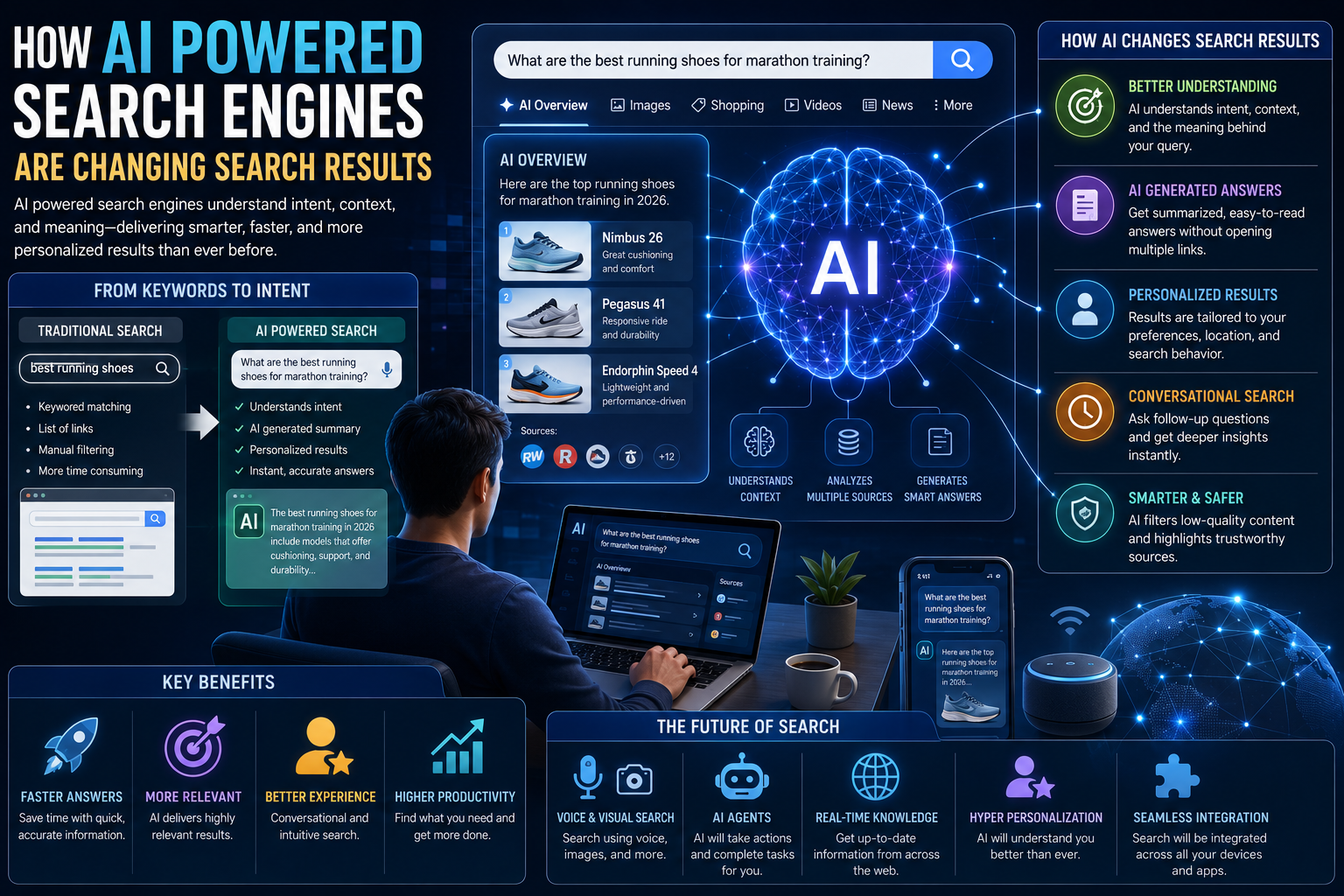
How AI Powered Search Engines Are Changing Search Results
How AI Powered Search Engines Are Changing Search Results – Search engines have been the foundation of the internet for decades. Whether people are looking for information, products, services, news, or entertainment, search engines serve as the primary gateway to online content. For many years, traditional search relied on keyword matching, backlinks, and ranking algorithms to determine which web pages appeared in search results.
However, the rise of artificial intelligence is fundamentally changing how search works. The emergence of AI Powered Search Engines is transforming the way users discover information online by making search more conversational, personalized, and context-aware. Instead of simply providing a list of links, modern AI-driven search platforms can understand user intent, summarize information, answer complex questions, and generate responses in real time.
In 2026, AI-powered search is becoming one of the most significant shifts in the digital landscape. Businesses, marketers, content creators, and consumers are all adapting to a new era where artificial intelligence plays a central role in how information is found and presented.
What Are AI Powered Search Engines?
AI Powered Search Engines are search platforms that use artificial intelligence technologies such as machine learning, natural language processing (NLP), large language models (LLMs), and generative AI to improve search experiences.
Unlike traditional search engines that primarily rank pages based on keywords and authority signals, AI-powered systems focus on understanding the meaning behind a user’s query.
These systems can:
- Interpret natural language
- Understand context
- Analyze user intent
- Generate summaries
- Provide direct answers
- Personalize results
- Handle complex questions
As a result, users can receive more accurate and relevant information with fewer searches.
The Evolution of Search Technology
To understand the impact of AI-powered search, it is important to look at how search technology has evolved.
Early Search Engines
The first generation of search engines focused largely on keyword matching.
If users typed a specific phrase, the engine searched for pages containing similar keywords.
While effective for simple searches, these systems often struggled to understand intent.
Link-Based Ranking
The introduction of link analysis significantly improved search quality.
Search engines began evaluating:
- Backlinks
- Page authority
- Relevance signals
- User engagement
This helped identify trustworthy and valuable content.
Semantic Search
Semantic search introduced the ability to understand concepts and relationships between words rather than focusing solely on exact keyword matches.
This represented a major advancement in search accuracy.
AI-Powered Search
Today’s search engines combine traditional ranking systems with advanced AI models capable of understanding language and generating responses.
This marks the beginning of a new era in information discovery.
How AI Powered Search Engines Work
AI-powered search engines rely on several advanced technologies.
Natural Language Processing
Natural Language Processing allows search systems to understand human language more effectively.
Rather than focusing only on keywords, AI can interpret:
- Context
- Intent
- Meaning
- Sentiment
- Relationships between concepts
This enables more conversational interactions.
Machine Learning
Machine learning algorithms continuously improve search quality by analyzing user behavior and search outcomes.
The system learns from interactions and refines future results.
Large Language Models
Large language models help search engines understand complex questions and generate coherent responses.
These models can process vast amounts of information and identify relevant insights.
Generative AI
Generative AI allows search engines to create summaries and answer questions directly rather than simply displaying links.
This capability is transforming user expectations for search experiences.
The Shift From Keywords to Intent
One of the most important changes brought by AI-powered search is the transition from keyword-based search to intent-based search.
Traditional search often required users to carefully choose specific keywords.
For example:
- “best smartphone 2026”
- “weather New York tomorrow”
- “symptoms of flu”
AI-powered search engines allow users to ask questions naturally:
- “What is the best smartphone for photography this year?”
- “Will it rain tomorrow in New York?”
- “How can I tell if I have the flu?”
The AI understands the intent behind the query and provides more relevant answers.
This makes search more intuitive and accessible.
AI Generated Search Summaries
One of the most visible features of modern AI-powered search is the ability to generate summaries.
Instead of requiring users to visit multiple websites, AI can provide concise answers based on information gathered from various sources.
Benefits include:
- Faster information discovery
- Improved user experience
- Reduced research time
- Simplified decision-making
Users can quickly understand key points before exploring additional sources.
However, this shift also raises important questions about traffic distribution and content visibility.
Personalization Is Becoming More Powerful
AI-powered search engines increasingly personalize search results.
By analyzing factors such as:
- Search history
- User preferences
- Location
- Device usage
- Behavioral patterns
AI can tailor results to individual users.
This personalization improves relevance and user satisfaction.
For businesses, it means understanding audience intent is becoming even more important.
Conversational Search Experiences
Search is evolving from a one-time query process into an ongoing conversation.
Users can now:
- Ask follow-up questions
- Refine requests naturally
- Explore topics interactively
- Receive contextual answers
This conversational approach resembles interactions with human assistants.
As AI systems become more sophisticated, conversational search is expected to become a dominant way people access information online.
Impact on Search Engine Optimization
The rise of AI-powered search is significantly affecting SEO strategies.
Content Quality Matters More Than Ever
AI systems prioritize content that demonstrates:
- Expertise
- Authority
- Trustworthiness
- Relevance
- Accuracy
High-quality content is more likely to appear in AI-generated responses.
User Intent Is Critical
Content creators must focus on solving user problems rather than simply targeting keywords.
Understanding search intent becomes increasingly important.
Structured Information Gains Importance
Well-organized content helps AI systems understand and summarize information effectively.
This includes:
- Clear headings
- FAQs
- Tables
- Bullet points
- Schema markup
Topical Authority Becomes Valuable
Websites that consistently publish comprehensive content on specific topics are more likely to earn visibility in AI-powered search environments.
Challenges for Publishers and Content Creators
While AI-powered search offers benefits for users, it also presents challenges for publishers.
Reduced Click-Through Rates
When AI provides direct answers, users may have less need to visit source websites.
This can reduce traffic to publishers.
Content Attribution Concerns
Publishers are increasingly concerned about how AI systems use and reference their content.
Questions surrounding intellectual property and fair attribution continue to evolve.
Increased Competition
AI-powered search may surface content from a broader range of sources, increasing competition for visibility.
Content creators must focus on producing unique and valuable information.
AI Powered Search in E-Commerce
Online shopping is another area being transformed by AI-powered search.
Consumers can ask detailed questions such as:
- “Which laptop is best for video editing under $1,500?”
- “What running shoes are best for marathon training?”
- “Which smartphone has the longest battery life?”
AI systems can analyze product information and provide personalized recommendations.
Benefits include:
- Faster purchasing decisions
- Improved product discovery
- Enhanced customer experiences
- Higher conversion rates
Retailers increasingly rely on AI-powered search technologies to improve online shopping experiences.
Voice Search and Multimodal Search
AI-powered search is expanding beyond traditional text queries.
Voice Search
Voice assistants allow users to perform searches through natural speech.
AI improves accuracy and understanding of spoken language.
Visual Search
Users can search using images instead of text.
Computer vision technology identifies objects and provides relevant information.
Multimodal Search
Multimodal AI combines:
- Text
- Images
- Audio
- Video
This allows users to interact with search engines in more flexible and intuitive ways.
The future of search will likely involve multiple input methods working together seamlessly.
The Role of Trust and Accuracy
As AI-generated answers become more common, trust and accuracy are becoming critical concerns.
Challenges include:
- Hallucinated information
- Outdated content
- Source verification
- Bias in AI models
Search providers are investing heavily in improving:
- Fact-checking
- Source attribution
- Transparency
- Quality controls
Maintaining user trust will remain essential for long-term success.
Industries Most Affected by AI Powered Search
Several industries are experiencing significant changes due to AI-powered search.
Publishing and Media
News organizations and content publishers must adapt to changing traffic patterns.
Digital Marketing
Marketers are adjusting SEO strategies to align with AI-driven search behavior.
E-Commerce
Retailers are leveraging AI search to improve product discovery and customer engagement.
Education
Students and professionals increasingly use AI search tools for research and learning.
Healthcare
AI-powered search helps users find health information more efficiently, although accuracy remains especially important.
Future Trends in AI Powered Search Engines
Several trends are expected to shape the future of search.
More Personalized Results
AI systems will continue improving individualized search experiences.
Real-Time Information Integration
Search engines will become better at delivering up-to-date information.
Greater Conversational Capabilities
Search interactions will become increasingly natural and interactive.
Enhanced Multimodal Search
Users will combine text, voice, images, and video in a single search experience.
AI Agents
Future AI search systems may actively perform tasks on behalf of users, such as making reservations, booking travel, or conducting research.
These capabilities could fundamentally redefine how people interact with the internet.
Conclusion
AI Powered Search Engines are transforming search results by moving beyond traditional keyword-based systems and toward intelligent, conversational, and personalized experiences. Through advances in natural language processing, machine learning, large language models, and generative AI, search engines can now understand user intent, generate summaries, and provide direct answers to increasingly complex questions.
While these innovations improve convenience and efficiency for users, they also create new challenges for publishers, marketers, and content creators. Success in the era of AI-powered search will depend on producing high-quality, trustworthy content that addresses user needs and demonstrates expertise.
As artificial intelligence continues to evolve, AI Powered Search Engines will play an increasingly central role in how information is discovered, consumed, and shared. The future of search is no longer just about finding links—it is about delivering meaningful knowledge and helping users accomplish their goals more effectively than ever before.
This content is sponsored by: https://ez96official.com/.


