
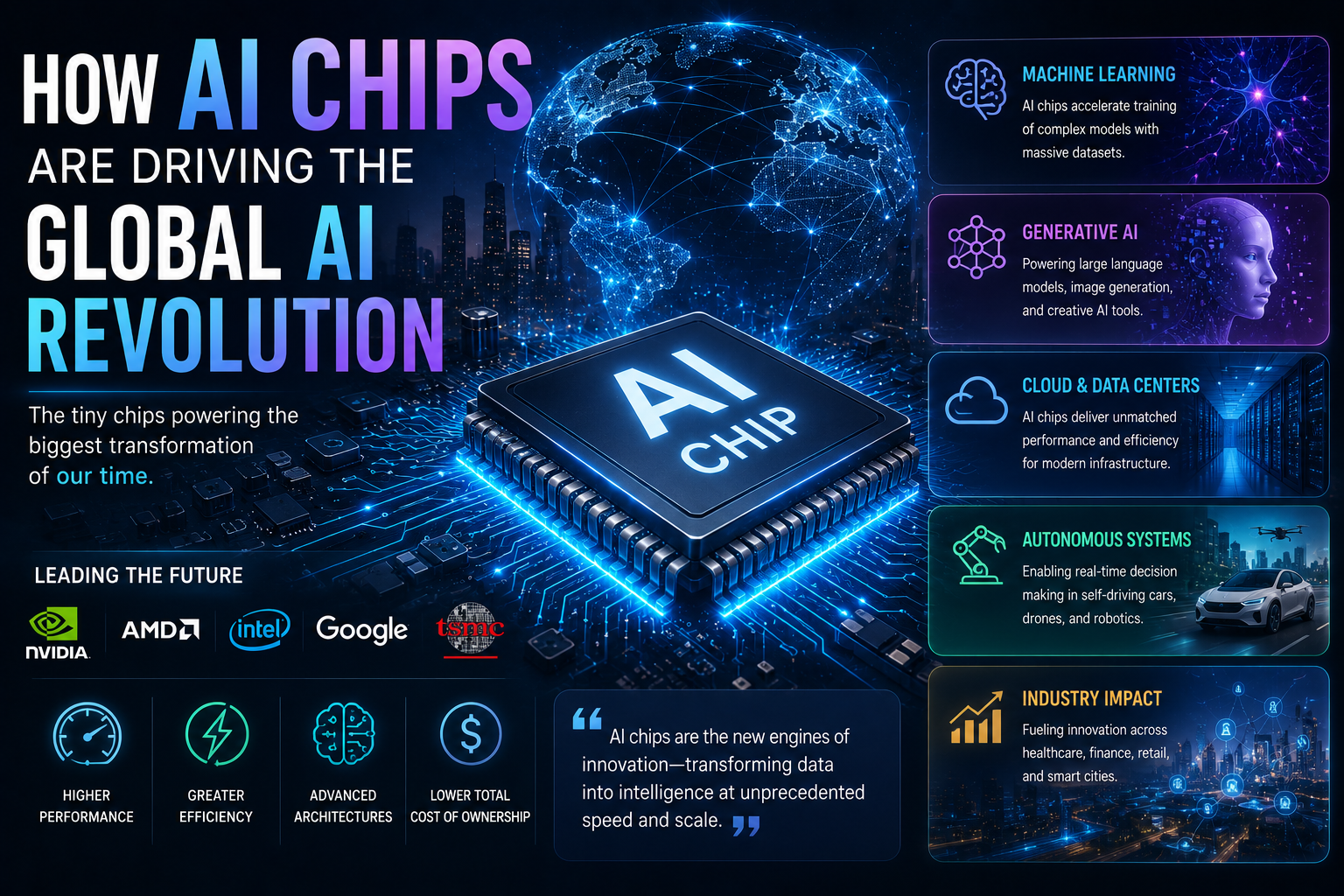
How AI Chips are Driving the Global AI Revolution
How AI Chips are Driving the Global AI Revolution – The journey of AI chips commenced in the mid-20th century when computers began to emerge, initiating a technological revolution. Early computers relied heavily on central processing units (CPUs) that were highly general-purpose but lacked the specialized capability needed for processing complex AI algorithms. The limitations of these systems prompted researchers to explore alternative architectures.
The pivotal moment in the evolution of AI chips came with the rise of parallel processing in the late 1990s and early 2000s. This architecture enabled multiple processing tasks to be executed simultaneously, significantly enhancing computational efficiency. The introduction of Graphic Processing Units (GPUs) during this era represented a major development in this context. Originally designed for gaming and graphical applications, GPUs demonstrated immense potential for AI applications due to their high throughput and ability to handle large volumes of data concurrently.
As the demand for machine learning and deep learning surged, the need for more tailored solutions led to the advent of Tensor Processing Units (TPUs) developed by Google in 2016. TPUs are specifically designed to accelerate machine learning tasks, providing significant speed enhancements compared to traditional processors. This diversification in chip architecture highlights the ongoing evolution, where specialized hardware is becoming critical in achieving optimal performance for AI tasks.
Furthermore, Moore’s Law, which predicts the doubling of transistor density on integrated circuits approximately every two years, played a crucial role in this evolution. It has enabled consistent and rapid growth in the performance of AI chips, fostering innovation within the semiconductor industry. Significant contributions from key players, such as Nvidia and Intel, have also shaped this landscape, aligning their advancements with the dynamic requirements of AI technology. Overall, the evolution of AI chips is characterized by a continuous adaptation to meet the growing complexity of AI algorithms and data processing needs.
The Role of AI Chips in Enhancing Machine Learning
Artificial Intelligence (AI) chips play a crucial role in streamlining machine learning processes, significantly impacting how data is processed, trained, and utilized across various applications. These specialized hardware components, designed explicitly for AI tasks, facilitate faster data processing capabilities, allowing for the rapid execution of complex algorithms that underpin machine learning models.
Among the different types of AI chips, Field-Programmable Gate Arrays (FPGAs) and Application-Specific Integrated Circuits (ASICs) stand out for their unique architectures tailored to meet specific needs within the machine learning domain. FPGAs are programmable silicon chips that can be configured and optimized for various workloads, making them versatile for different machine learning tasks. Their ability to be reconfigured enables developers to enhance performance and adapt to the evolving requirements of AI applications efficiently.
ASICs, on the other hand, are custom-designed chips optimized for particular algorithms, yielding extraordinary efficiency and performance in tasks such as deep learning and neural network training. Their architecture allows for the handling of large datasets with minimal energy consumption and higher processing speeds compared to traditional CPUs or GPUs. This energy-efficient processing is vital as organizations increasingly utilize AI technologies to drive innovation and efficiency within their operations.
The implications of these advancements in AI chips are profound, propelling businesses toward achieving quicker model training times and enabling them to analyze vast data volumes more effectively. As industries increasingly adopt AI technologies to remain competitive, the importance of leveraging machine learning through the use of specialized AI chips will continue to grow, shaping the landscape of technological innovation and operational efficiency in the future.
The Global Market Impact of AI Chips
The rise of Artificial Intelligence (AI) has significantly influenced the global market, primarily due to the proliferation of AI chips. These specialized semiconductor devices are engineered to facilitate AI tasks, leading to a robust growth trajectory for the AI chip market. According to various industry reports, the market has witnessed a compounded annual growth rate (CAGR) of over 30% in recent years, reflecting an increasing demand for AI-driven applications across different sectors.
Investments in AI-centric technologies are transforming traditional paradigms, with companies reallocating resources towards the development of AI chips. Major tech behemoths and startups alike are channeling funds into research and development to obtain a competitive edge in this burgeoning market. This trend signifies a shift from conventional chip manufacturing to a focus on versatility and performance, further underscoring the importance of AI capabilities in modern-day processing solutions.
The competitive landscape is becoming increasingly multifaceted, with established players facing challenges from emerging firms specializing in niche AI applications. Various companies are working collaboratively and competitively to enhance their offerings, leading to innovations that are critical for handling complex algorithms and vast data processing needs. Furthermore, companies are also grappling with geopolitical factors, such as trade restrictions and national security concerns, which could affect the supply chain of AI chip manufacturing and influence the overall market dynamics.
Emerging markets, particularly in Asia-Pacific and Latin America, showcase significant growth potential, reflecting an increased investment in AI technologies. As the integration of AI chips expands into autonomous vehicles, edge computing, and the Internet of Things (IoT), future trends will likely emphasize sustainability and efficiency. These advancements reveal an intersection of technological progress and economic viability, further elevating the prominence of AI chips in shaping the global economy.
Future Trends and Innovations in AI Chip Technology
The landscape of artificial intelligence (AI) is rapidly evolving, fueled by significant advancements in AI chip technology. The next wave of innovations is expected to focus on several key trends, notably neuromorphic computing, quantum processing, and energy-efficient chip designs.
Neuromorphic computing, inspired by the human brain’s architecture, represents a ground-breaking approach to AI chip development. These chips emulate neural networks, allowing for advanced processing capabilities. By mimicking brain-like efficiency, neuromorphic chips can enable more complex AI models to operate in real-time, opening up possibilities in areas such as edge computing and the Internet of Things (IoT).
In addition to neuromorphic computing, quantum processing presents another frontier for AI chip technology. Quantum chips utilize the principles of quantum mechanics, enabling unprecedented computational power. As research in quantum computing progresses, it is anticipated that these specialized chips will significantly improve the performance of AI systems, leading to breakthroughs in various domains, including cryptography and complex system simulations.
Energy efficiency is another critical trend shaping the future of AI chips. As data centers and cloud computing continue to expand, there is a pressing need for sustainable solutions to manage energy consumption. Innovations in chip design that prioritize low power consumption will not only reduce operational costs but also minimize the environmental impact of AI systems, making them more viable in a broader range of applications.
Moreover, partnerships and collaborations among tech companies, research institutions, and industry consortia will be essential to drive innovation in AI chip technology. By pooling resources and expertise, stakeholders can accelerate the development of cutting-edge chips that will underpin future AI applications across industries such as healthcare, robotics, automotive, and beyond.
As these trends develop, the potential applications of AI chips are vast, promising significant advancements in the ability of machines to learn, adapt, and perform complex tasks autonomously. The trajectory of AI chip innovation will undoubtedly play a pivotal role in shaping the future of artificial intelligence.
This content sponsored by https://www.ez96live.com/


