
From AI to AR: Understanding the Power of Spatial Computing
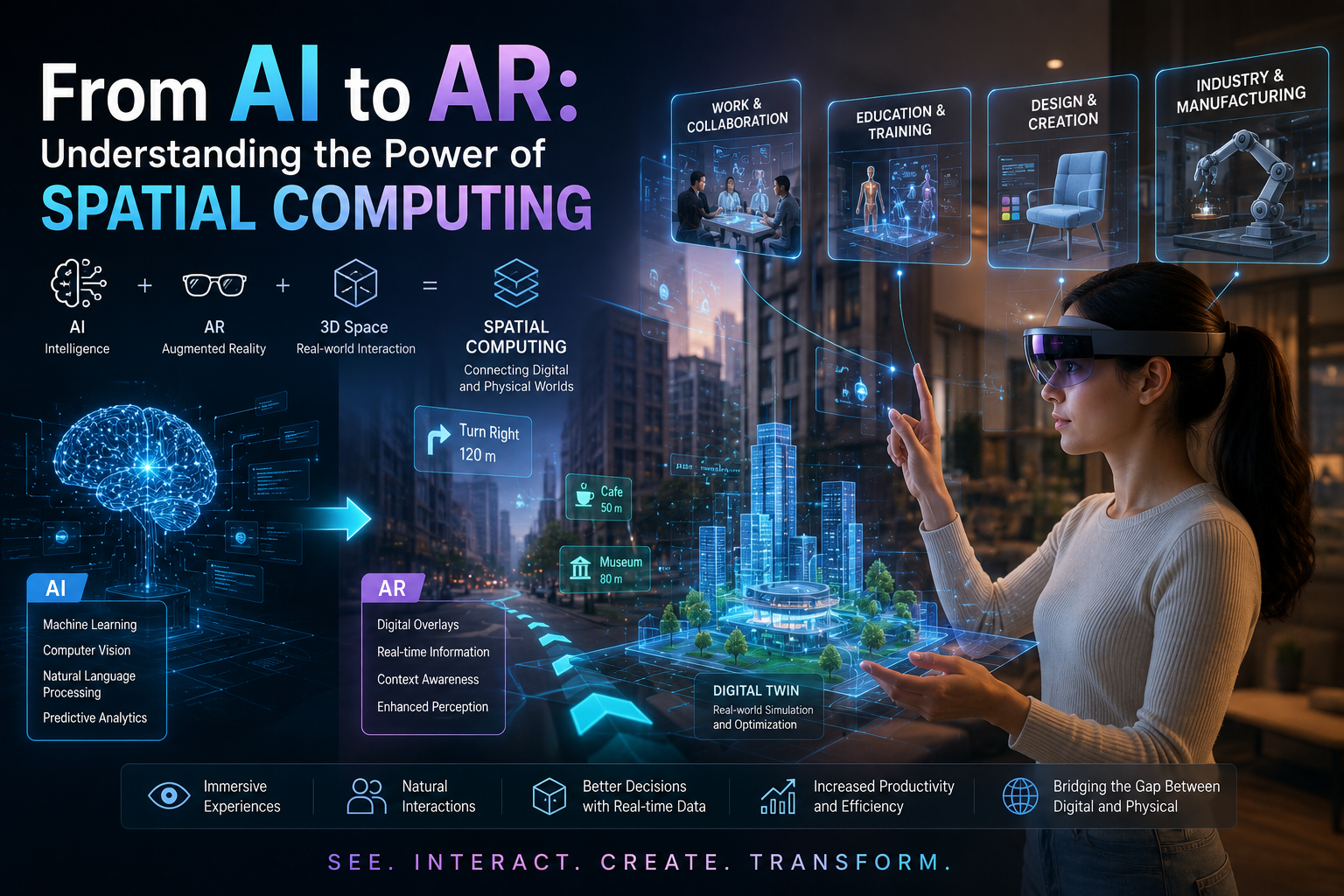
From AI to AR: Understanding the Power of Spatial Computing – Spatial computing is a transformative technology that merges the physical and digital realms, enabling users to interact with their environments in a more intuitive and immersive manner. This integration is achieved through various components, the most prominent being augmented reality (AR), virtual reality (VR), and mixed reality (MR). Each of these elements contributes uniquely to the overall spatial computing experience.
Augmented reality (AR) enhances the user’s perception of the real world by overlaying digital information onto physical environments. This interaction can range from simple visual enhancements, such as displaying directions in navigation apps, to complex data visualizations that provide insights into environmental conditions. AR applications are already revolutionizing industries such as education, healthcare, and retail by enriching user interactions with intelligent, context-aware data.
Virtual reality (VR), on the other hand, immerses users in entirely digital environments, often requiring a headset to block out the physical world. VR is particularly beneficial in training simulations, gaming, and therapeutic settings, allowing users to experience scenarios that may be impractical or unsafe in real life. By simulating real-world situations, VR helps reinforce learning and enhances engagement.
Mixed reality (MR) takes this a step further by combining aspects of both AR and VR. In mixed reality experiences, digital objects not only coexist with the physical world but can also interact with it in real time. This capability is powered by advanced sensors and machine intelligence, which develop an understanding of the user’s context and surroundings. As a result, MR facilitates a deeper engagement with both types of environments.
The significance of spatial computing lies in its potential to enhance how users interact with technology. By allowing for seamless integration of digital experiences into the physical world, spatial computing fosters a more engaging, efficient, and accessible user experience. As these technologies continue to develop, their impact on our daily lives is expected to grow, making spatial computing an essential topic of interest.
The Role of Artificial Intelligence in Spatial Computing
Artificial Intelligence (AI) serves as a cornerstone in the evolution of spatial computing, infusing capabilities that enhance how machines understand and interact with the physical world. The integration of AI technologies such as computer vision, natural language processing (NLP), and machine learning is crucial for creating intelligent spatial computing applications. By harnessing these technologies, systems can analyze spatial data, recognize patterns, and make informed decisions, significantly improving user experiences.
Computer vision enables machines to interpret visual information from the world around them. In spatial computing, this technology allows devices to identify objects, track movements, and understand spatial relationships. For instance, AI-powered applications in augmented reality (AR) can detect and overlay digital information onto physical environments, providing users with a rich interactive experience. Popular video games that utilize AR overlays exemplify how computer vision contributes to spatial awareness, creating immersive environments that respond to physical surroundings.
Natural language processing further enhances spatial computing capabilities by allowing users to interact with systems through voice commands or text. For example, smart assistants equipped with NLP can interpret user queries about their immediate environment, streamlining interactions in smart homes or during navigation in complex urban spaces. This integration facilitates a more intuitive way for users to access and manipulate spatial information.
Machine learning, another integral AI technology, empowers spatial computing systems to learn from data and improve their functionality over time. By analyzing user interactions and environmental factors, machine learning algorithms can refine object recognition capabilities and better understand context. Applications in autonomous vehicles illustrate this power, as these vehicles rely on AI to navigate and interpret their surroundings, adapting to changing conditions and improving safety.
Applications and Impact of Spatial Computing
Spatial computing has emerged as a transformative force across various industries, significantly shaping how we interact with digital information in a three-dimensional context. One of the most notable applications of this technology is in the gaming sector, where developers are increasingly leveraging augmented reality (AR) and virtual reality (VR) to create immersive experiences. Games that integrate spatial computing allow players to interact with their environment in unprecedented ways, creating not just entertainment but engaging social interactions.
In education, spatial computing has revolutionized learning methodologies. Institutions are utilizing augmented and virtual reality technologies to create immersive learning environments, enhancing student engagement and retention. By simulating real-world scenarios, learners can practice complex skills through training simulations, ranging from medical procedures to engineering projects, thus bridging the gap between theoretical knowledge and practical application.
The healthcare industry is experiencing profound advancements due to spatial computing. Surgeons, for instance, are employing augmented reality to superimpose critical information onto their field of view during operations, improving precision and outcomes. Additionally, medical training programs use VR simulations to familiarize students with surgical techniques in a safe and controlled environment, preparing them better for real-life situations.
Real estate is another sector benefiting from the applications of spatial computing. Virtual property tours utilizing 3D modeling allow potential buyers to explore homes remotely, enhancing the property viewing experience. This innovative approach not only saves time but also enables agents to showcase properties more effectively, ultimately driving sales.
Current trends suggest that the potential of spatial computing will continue to expand, with industries increasingly adopting these technologies to create more effective, engaging, and efficient solutions. As spatial computing evolves, we can anticipate its integration across various domains, fundamentally changing how we work and interact with our surroundings.
The Future: Challenges and Opportunities
As we look toward the future of spatial computing, it is essential to recognize both the challenges and opportunities that lie ahead. This burgeoning field, which encompasses technologies such as augmented reality (AR) and virtual reality (VR), is poised to revolutionize various sectors, yet it also faces significant hurdles that must be addressed to achieve its full potential.
One of the primary challenges is the technical limitations inherent in current spatial computing technologies. For instance, hardware capabilities often dictate the performance and user experience, necessitating advancements to provide seamless integration of digital information with the physical world. Moreover, ensuring compatibility across devices and platforms is crucial to drive widespread adoption. Without a cohesive framework, users may experience fragmented interactions that hinder innovation.
Privacy concerns also loom large in the realm of spatial computing. As these technologies become more interconnected, the potential for data misuse and breaches increases. Companies will need to prioritize robust security measures while navigating the complex ethical implications of collecting and utilizing user data to enhance experiences. Building trust among consumers will be essential for the industry to flourish.
Furthermore, the need for standardization cannot be overstated. As spatial computing evolves, establishing clear standards will facilitate interoperability and improve user experiences across different devices and software. Stakeholders, including developers and regulators, must collaborate to create guidelines that support growth while fostering innovation.
Despite these challenges, the future of spatial computing is rife with opportunities. Organizations that embrace this technology can streamline operations, enhance customer engagement, and unlock new revenue streams. As the industry matures, businesses and consumers alike will need to remain adaptable and informed to leverage the full spectrum of benefits that spatial computing offers.